
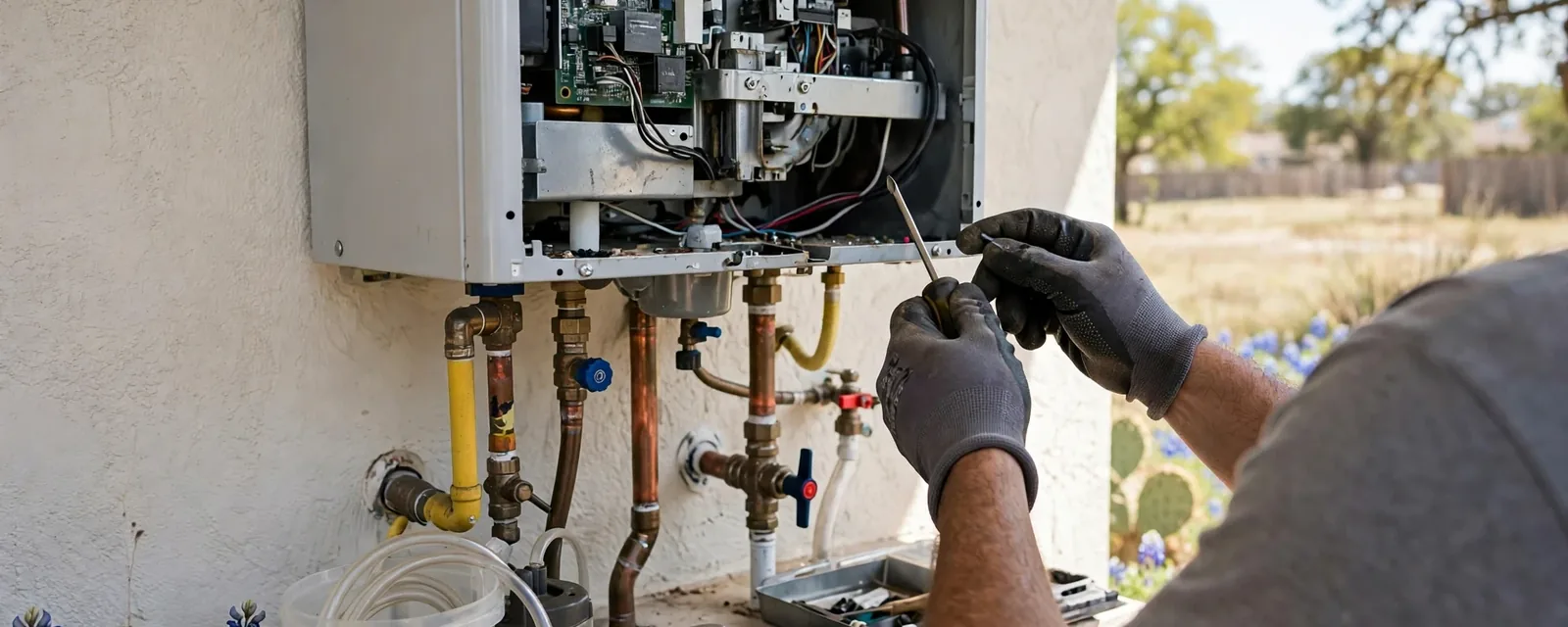
A tankless water heater, also called an on-demand heater, warms water only while a tap is open, using a gas burner or electric elements and a heat exchanger. There is no storage tank to run empty. Milton Pro Plumbing handles flushing, service and installation questions, and says up front when a particular unit is outside what the plumber can work on.
Questions people ask about tankless water heaters
Ask on the phone. Some shops only service units they sold, and some only replace. Give the make, the model number on the data label and any error code on the display. The plumber can tell you whether the visit is a flush, a repair, or a replacement before anyone drives out.
Many makers call for a flush about once a year, and more often where water is harder. Your manual sets the interval. Milton water hardness is not published here, so ask Milton Water and Sewer for the current water quality report, or test a sample, to judge how fast scale will build.
That is the cold water sandwich. Warm water in the pipes passes, a slug of cold water that was sitting in the heater arrives, then hot water returns once the unit fires. Low flow fixtures that fall below the unit's minimum flow can also make the burner shut off. A plumber can test the flow rate.
Codes vary by maker, but common causes are scale on the heat exchanger, a blocked vent or condensate drain, a flame sensor fault, or low incoming gas. Write the code down, note when it appears, and check the manual. Do not reset the unit repeatedly. Gas faults need a licensed professional.
It can be if space is tight and you want endless hot water for long showers. It may not be if your gas line is small or your house has few bathrooms. The table below sets out the trade-offs, and the plumber can talk through your usage before you commit.
Yes. Any replacement of a water heater needs a permit from the local plumbing inspector, pulled by a licensed plumber. Property managers should ask to see the permit and keep a copy with the unit's paperwork.
Shut off the water to the unit and turn off its power or gas, then call. A leak can come from a fitting, the condensate line or the heat exchanger. A cracked heat exchanger means replacement, but the other causes are often repairable. Our line runs 24/7 for floods.
Rather talk it through? Call and ask a plumber.
(617) 752-0573Hot water runs out in back to back showers, or the unit shows an error code
Both problems usually trace to the same place: flow, scale or fuel. A tankless heater can only heat as many gallons per minute as its burner or elements allow, so two showers plus a dishwasher can exceed the rating. An error code often means the heat exchanger is coated with minerals or the vent has an obstruction.
A plumber who works on tankless water heater systems starts with the flow rate, the incoming temperature, the gas pressure and the code history. Tell the plumber what happens, when it happens and what the display says, and the visit goes much faster.
The cold water sandwich, explained
When you open a tap, the heater has to detect flow before it fires. Water already in the pipe between the heater and the tap is whatever temperature it cooled to. After you shut a tap and reopen it quickly, the heater may still hold a pocket of cold water that arrives between two warm streams.
Several things reduce it. Keeping a tap open a bit longer, moving the heater closer to the fixtures, adding a small buffer tank or a recirculation setup, and using fixtures with a flow above the unit's minimum all help. None of these is a magic cure, so ask what fits your piping.
Flushing and descaling a tankless heater
A flush circulates a mild acid solution, often white vinegar or a manufacturer approved descaler, through the heat exchanger using a small pump and two hoses attached to service valves. The solution dissolves mineral scale. Then clean water rinses it out. Without isolation valves on the unit, the plumber has to add them first.
Why it matters: scale is a thin, stony layer that acts as insulation. The heat exchanger has to burn longer for the same temperature, flow drops, error codes appear and parts wear faster. Milton, Canton and Quincy hardness figures are not published here, so test your water or ask the utility for its latest report.
For nearby context only, Randolph's 2024 report listed hardness of 39.6 ppm and Braintree's listed 47.8 mg/L. Those are their numbers, not Milton's, so they cannot stand in for a test at your tap.
Questions about tankless water heater? Call a plumber
Licensed plumbers are dispatched day and night, and you hear the price before work starts.
Tankless pros and cons
| Point | What helps | What to weigh |
|---|---|---|
| Hot water supply | No tank to empty, steady output on a single long draw | Output caps at gallons per minute, so several fixtures at once can overload it |
| Space | Small wall mounted unit frees floor space | Needs wall clearance and a service path |
| Fuel and utilities | Gas models heat quickly | Larger gas line and sometimes heavier electrical service |
| Maintenance | Longer service life on a well kept unit | Needs periodic flushing, and scale hurts it faster than a tank |
| Repairs | Modular parts can be swapped | Some shops will not service units they did not install |
The listed trade-offs are general. Your fuel, plumbing and habits decide the outcome.
Gas line and venting considerations
Gas tankless models draw a lot of fuel in a short time. The gas pipe that fed a tank may be too small once the run length and other appliances are counted. The plumber has to size the gas line to the unit's maximum input, and gas fitting work involves its own licensing, so ask who is licensed to do it.
Exhaust is the second item. Many units vent through a small diameter pipe made of a specific material, run to an outside wall. Condensing models also need a drain for acidic condensate. Vent length, bends and termination height all come from the manufacturer's instructions. Getting the vent wrong is a safety issue, not a cosmetic one. According to the Board's policy statement, installs must follow the manufacturer's instructions and sizing guides, so ask any installer which guide they used.
What affects tankless service and install pricing
A clear price is given before work starts. These drivers explain the range of jobs.
Service or replacement
A flush is a defined service call, while a failed heat exchanger can mean a new unit.
Isolation valves
If they are missing, they must be installed before a proper flush.
Gas and venting changes
Bigger gas pipe, new vent material and a condensate drain change the scope.
Parts access
Some units need maker parts that take time to arrive.
Maintenance and wear are not usually covered by homeowners insurance. Sudden water damage might be, and policy wording decides, so read it or ask your insurer.
Switching from a tank, and where to read more
Moving from a storage tank is a project rather than a swap, covered under water heater installation. A failing tank is handled on the replacement page. Households in Braintree or elsewhere nearby ask the same sizing questions.