
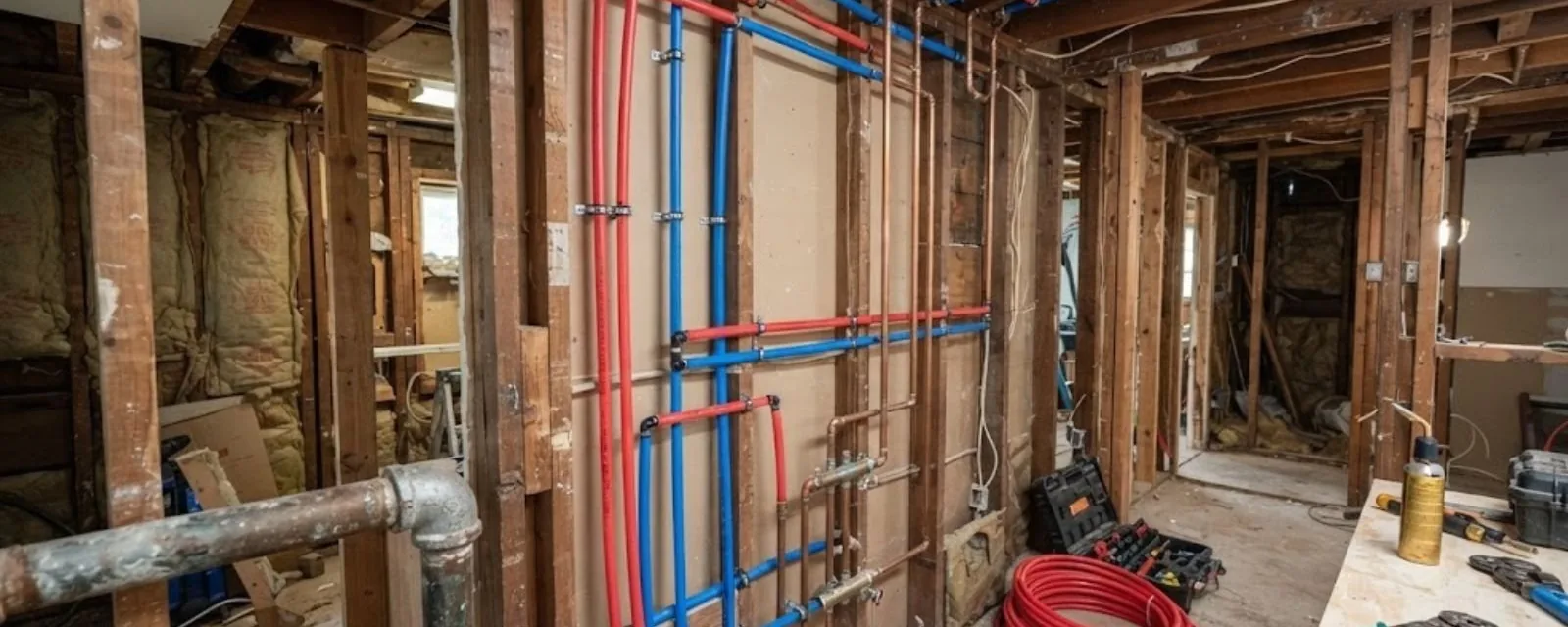
Homes in Milton usually contain several pipe materials at once: copper or PEX for water supply, cast iron or plastic for drains, and sometimes old galvanized steel or lead hiding in a basement or under the street connection. You can tell most of them apart with a magnet, a key and a flashlight. Each material has its own typical age, color and way of failing.
Knowing what you have helps you judge whether a leak is a one-time repair or a sign that a whole run is wearing out.
Quick identification: material, where it hides, how it fails
Start here. Find the pipe you are looking at and compare the color, magnet test and location.
| Material | Where you find it | How it fails |
|---|---|---|
| Copper | Exposed supply lines in basements and utility rooms, reddish brown or green with age | Pinhole leaks from corrosion, joints that weep, bursts after freezing |
| Galvanized steel | Gray, threaded pipe on older supply lines, magnet sticks | Rust builds up inside, pressure drops, rust-colored water, leaks at threads |
| Cast iron | Heavy black or gray drain stacks and main drain under the basement floor | Rusts through from inside, cracks at joints, roots enter, slow drains from scale |
| PVC | White or cream drain, waste and vent lines in newer work | Cracks from impact, glued joints can separate, becomes brittle in sunlight |
| ABS | Black plastic drain pipe, common in additions and remodels | Joint failures, cracks when struck, sags if unsupported |
| PEX | Flexible red, blue or white tubing on supply lines, often in remodels | Fittings leak, UV damage if left in sunlight, kinks or chews from rodents |
| Lead | Soft dull gray pipe near the water meter, scratches bright silver | Does not leak often, but can release lead into drinking water |
Color alone is not proof. If you are unsure, a licensed plumber can identify the material in minutes.
Three tests you can do at the meter in ten minutes
These tests need no tools beyond a key, a magnet and a flashlight. Do them where the water line enters your house, usually near the meter in the basement.
Look at the color
Reddish brown or green means copper. Dull gray with threaded fittings suggests galvanized steel. A soft, dull gray pipe with a bulge at the joints may be lead.Use the magnet
A magnet sticks to galvanized steel and cast iron. It does not stick to copper, lead or plastic.Scratch with a key
Gently scratch a small spot on the pipe near the meter. Lead scratches to a shiny silver and feels soft. Copper shows a bright orange metal. Do not scrape hard or cut into the pipe.
Copper: the long-lived workhorse that still wears out
Copper supply pipe in Type L or Type M wall thickness lasts for decades when the water is gentle on it. Pinholes form when water chemistry, high velocity or poor soldering attack the wall from inside. A green crust at a joint signals a slow weep.
A single pinhole does not always mean the whole run needs replacing. Several leaks in one season usually do, because the pipe wall is thin everywhere. At that point a repipe costs less than paying for repair after repair.
Galvanized steel: why old homes lose water pressure
Galvanized pipe is steel with a zinc coating. The zinc wears away, the steel rusts, and the opening narrows. A three-quarter inch pipe can end up the size of a pencil lead inside, which is why showers in old houses run weak while the water meter shows normal use.
Low pressure at every fixture, orange water after a night of no use, and threads that weep are the three signs. Galvanized pipe cannot be cleaned or lined in a practical way, so replacement is the usual fix once symptoms are widespread.
Cast iron, PVC and ABS: the drain side
Cast iron drains were standard in older homes and are still used in many stacks because they muffle noise. Scale grows on the inside until the pipe slows down. A camera inspection shows whether the pipe is merely rough or actually cracked.
PVC and ABS replaced cast iron in most new work. They are light, smooth and cheap to install. Both need support every few feet, and solvent-glued joints must be cured and clean to hold. Mixing PVC and ABS requires a transition cement, so a repair patch that uses the wrong glue can fail later.
PEX: flexible tubing and its limits
PEX is cross-linked polyethylene tubing sold in red for hot, blue for cold and white for either. It bends around corners, so it needs fewer fittings than rigid pipe. That makes remodels faster and often reduces the number of joints that could leak.
PEX does not belong in direct sunlight, near a hot flue or where rodents can chew it. The fittings, not the tubing, cause most problems. Ask what fitting system the plumber uses and whether the manifold or valves stay accessible.
What to do if you find lead
Finding a lead service line is not an emergency, but it is a reason to act. Until it is replaced, run the cold tap for 30 seconds to two minutes if water has sat for hours, and never use hot tap water for drinking or cooking because hot water pulls more metal from pipes.
A plumber cannot tell you whether your water is safe to drink. For that, ask Milton Water and Sewer for the current water quality report. The Town owns the street side of the line, you own the house side, so ask the Division how a replacement would be coordinated before anyone digs.
When a pipe problem is more than a patch
Patch repairs make sense for a single failure in an otherwise sound pipe. Replacement makes sense when failures repeat, pressure drops everywhere, or the material itself is the hazard. Massachusetts requires that work be done by a master or journeyman plumber licensed by the state, and the local plumbing inspector must issue a permit before piping is replaced.
If a pipe has already burst, shut off the main valve first and then call for burst pipe repair. Replacing the failed section is the easy part. Finding out what caused it is what prevents a second burst.
Milton, MA specifics: age of homes and who owns which pipe
Source type: Town of Milton Housing Production Plan, Town of Milton lead service line inventory page, MWRA community page
The Town's Housing Production Plan, based on the 2010 Census, found that 46.8 percent of Milton homes were built in 1939 or earlier and 28.5 percent between 1940 and 1959. That puts about three quarters of the housing before 1960, with a median age of 71 years. Pipes from those eras were often galvanized steel, lead, or early copper with cast iron drains, so expect to find at least one old material in the walls or basement.
The water service line has two owners. The Town maintains it from the street main to the curb stop valve, and you maintain it from the curb stop into the house. Because your section carries your risk, knowing its material matters, especially where it enters the basement wall.
Milton has built a lead service line inventory and filed a replacement plan with MassDEP in October 2024. The inventory is the place to check what the Town records for your address. Call the Water and Sewer Division at 617-696-5731 and ask what material they list for your service line, then confirm it yourself at the meter.
MWRA treats the water with sodium carbonate and carbon dioxide to adjust alkalinity and pH so less lead and copper dissolves from home plumbing. That treatment helps, but it does not replace a lead pipe. If your inspection finds one, plan its replacement instead of relying on treatment.
Questions readers ask about this topic
Check color and use a magnet. Copper is reddish brown and non-magnetic. Galvanized steel is gray and a magnet sticks. Plastic pipe is white, cream, black or colored tubing. A licensed plumber can confirm any pipe in a few minutes with a quick inspection.
Copper and cast iron can both last many decades, but how long depends on water conditions and installation. Plastic is durable against corrosion. Galvanized steel is the shortest-lived supply material, since the zinc coating fails and the pipe rusts from inside.
Neither is better for every house. PEX handles freezing better because it can expand, goes in quickly and uses fewer joints. Copper resists heat, sunlight and rodents. Pick based on the layout, access and what the plumber is confident installing.
In Massachusetts the local plumbing inspector must issue a permit before piping is installed, altered, removed, replaced or repaired, and only licensed plumbers can pull one. Minor repairs such as fixing a leaky faucet do not need a permit. Ask the plumber to show you the permit.
Possibly, since many homes there date before 1960. The Town has built a lead service line inventory, so call the Water and Sewer Division at 617-696-5731 and ask what it lists for your address. Then check the pipe at the meter with a magnet and a key, because records can be incomplete.
Rather talk it through? Call and ask a plumber.
(617) 752-0573