
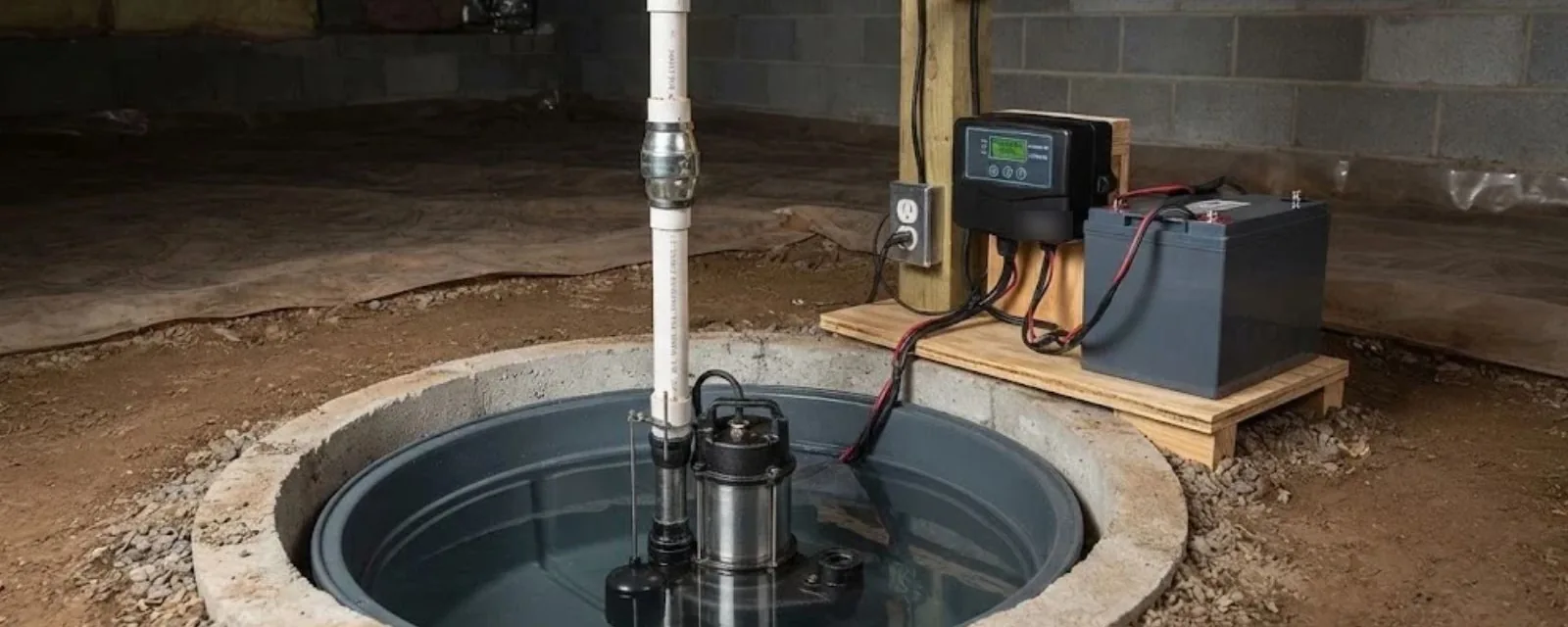
A sump pump installation means cutting a pit into the lowest part of your basement floor, setting a pump inside it, and running a discharge pipe outside so groundwater leaves before it reaches your living space. On a plain concrete floor the job usually fits in one working day. Three parts decide whether it works: a correctly sized pit, a pump that matches the water you actually get, and a discharge route that carries water well away from the house.
This guide covers how to tell if you need one, how the work goes, what moves the price, and how to compare quotes without a dollar figure being the only thing you look at.
Signs your basement needs a pump and not just a dehumidifier
Dampness and flooding are different problems. A dehumidifier handles humid air. A sump pump handles liquid water arriving from the soil. If you see any of the signs below, water is coming in faster than evaporation can remove it.
- Water appears at the floor and wall joint within a day or two of heavy rain or snowmelt.
- A tide mark or white mineral crust sits on the lower foundation wall or on stored boxes.
- The floor drain or an existing pit holds standing water after storms.
- Carpet or stored items smell musty or feel damp from underneath.
- Your neighbors have pumps and run them after every storm.
How the installation goes, step by step
Every house differs, but a standard installation on a concrete slab follows this order. Ask the plumber to walk you through their version before work begins.
Find the low spot
The plumber checks where water enters and which corner of the floor is lowest. The pit goes where water naturally gathers, not wherever is most convenient.Cut and dig the pit
A saw opens a square in the slab, usually about two feet across. The crew digs down to fit a plastic basin, then sets gravel in the bottom.Set the pump and check valve
The pump sits level in the basin with its float free to rise. A check valve on the discharge pipe stops water from falling back into the pit after each cycle.Run the discharge pipe
Rigid pipe, often 1.5 inch, leaves the house through the rim joist and ends outside where water can drain away from the foundation. A sealed lid and vent pipe finish the pit.Patch, test and label
The slab is patched with concrete. The plumber fills the pit with water to confirm the float turns the pump on and off, and checks the outlet for leaks.
Pump types and where each one fits
The right choice depends on how often water arrives and what happens when the power fails.
| Pump type | Best fit | Trade-off |
|---|---|---|
| Submersible | Most finished or lived-in basements, since it runs quietly inside the pit | Harder to reach for service because it sits underwater |
| Pedestal | Narrow pits and unfinished basements where noise is not a concern | Louder, and the motor is exposed above the pit |
| Battery backup | Homes where storms cut power, which is exactly when water rises | Battery needs testing and replacement on a schedule |
| Primary plus backup pair | Properties near tidal or brook flooding with repeated storm cycles | Two pumps and two floats cost more to install and maintain |
Plumbers size pumps by how much water arrives and how high it must be lifted, not by horsepower alone.
What changes the price of an installation
Two houses with the same pump can get very different quotes because the work around the pump differs. The biggest driver is the floor. A bare concrete slab cuts quickly, while a floor with tile, a finished room or a layer of thick old concrete adds hours of labor and cleanup.
The discharge run is the next big item. A pit near an exterior wall needs a short pipe. A pit in the middle of the house may need a long run through joists and a trench outside. If a trench is needed, Massachusetts law requires a call to Dig Safe at 811 at least 72 business hours before anyone digs, and homeowners must call as well.
Pump choice, a backup system, a sealed lid, a battery and any electrical work for a dedicated outlet all add to the total. A clear price before work starts should list each of these so you can see what you are paying for.
How to compare two or three quotes fairly
A lower number is not always a lower cost. Compare what each plumber puts into the pit, not just what they charge. Ask each one the same questions and write the answers side by side.
Ask whether the quote includes a check valve, a sealed lid, a vent, concrete patching and removal of the dug-out soil. Ask where the discharge ends and how far from the foundation. Ask whether a backup pump or battery is priced separately. A quote that leaves these out often grows later.
- Confirm the plumber is licensed by checking the Mass.gov eLIPSE portal, or call the Board of State Examiners of Plumbers and Gas Fitters at 617-727-9952.
- Ask which permit applies. A new pump discharge involves plumbing work, so ask the Milton plumbing inspector what the Town requires.
- Ask what warning you will get if the pump fails, such as an alarm, and who services it.
Where the water goes after it leaves the pit
Discharge is where many DIY and rushed installations go wrong. Pumped water should end on your own lot, several feet from the foundation, on ground that slopes away. Pointing it at the foundation just sends the same water back into the basement.
Never connect the discharge to a sanitary sewer line without written approval. Clean groundwater in a sewer can overload the system during storms, which is why towns write rules about it. If you are unsure, a sump pump plumber can route the pipe to daylight instead.
When a pump will not be enough
A pump removes water that has already gathered in the pit. It does not stop water from entering through a failing wall, a cracked slab or a bad gutter. If you see water streaming through the wall rather than rising from the floor, ask about exterior drainage or interior drain tile.
Also check the simple things first. Gutter downspouts that empty beside the house and soil that slopes toward the foundation put water where the pump has to fight it. Fixing those is cheap compared with replacing a worn-out pump every few seasons.
Milton, MA specifics: river, brooks and older basements
Source type: Town of Milton resilience workshop findings, Housing Production Plan and Braintree water report
The Town's 2020 resilience workshop found that flooding is concentrated along the banks of the Neponset River, which is tidal. Flooding below the dam often lines up with king tides. If your house sits near the river, expect groundwater to rise on a schedule you can predict from the tide calendar, so ask the plumber to size the pit and pump for repeated, high-volume cycling rather than an occasional shower.
The same workshop reported flooding near Turner's Pond, Pine Tree Brook and Unquity Brook, and named Central Avenue, Granite Avenue and Brook Road as commonly flooded roads. A basement near those waters can take in seepage even when your own lot looks dry. Walk the outside of your foundation after a heavy rain and tell the plumber where water pools, because that tells them where the discharge pipe should not go.
About 46.8 percent of Milton homes were built in 1939 or earlier, and the median housing age is 71 years. Older foundations are often fieldstone or early poured concrete with cracks and open joints, so water can enter at several points. That is why a pump alone sometimes needs basement waterproofing work alongside it.
The Town also heard that storm surge in East Milton has pushed sewers back up into homes. A sump pump cannot stop that, because it moves groundwater, not sewage. Keep the two systems separate and ask Milton Water and Sewer about the sewer side.
Braintree's water report states that sump pumps there must discharge away from the sewer, with inspections and an amnesty period for rerouting. Braintree publishes this rule, and Milton may or may not have the same one. Ask Milton Water and Sewer at 617-696-5731 before you connect any pump discharge to a drain.
Questions readers ask about this topic
Most standard installations on a concrete slab finish within a single working day. Add time if the floor is finished, if the discharge needs a trench, or if the electrician must add a dedicated outlet. Concrete around the pit needs time to cure before heavy use.
If storms often knock out power in your neighborhood, a backup is worth considering because heavy rain and power loss tend to arrive together. A battery system or a second pump on its own float keeps the pit working. Ask the plumber how long the battery runs and how you test it.
Pour a bucket of water into the pit every few months and watch the float lift and the pump switch on. Listen for odd grinding. Clear debris from the pit and check that the outside end of the discharge pipe is not blocked.
A pump that cycles often wears faster than one that rarely runs. Replace it when it makes grinding noises, runs without pumping, or fails the bucket test. Waiting for it to fail in a storm is the expensive way to find out.
Many towns forbid it, and the rule can differ by town. Braintree publishes a rule that sump pumps must discharge away from the sewer, but that does not tell you Milton's rule. Ask Milton Water and Sewer before connecting anything, and keep the pit separate from the sewer line.
It depends on where the water comes from. A pump handles groundwater that seeps into the pit, even when the river is high. It cannot hold back surface flooding that enters through windows or doors, or sewage that backs up through drains. A plumber can tell you which problem you have. Neighbors in Quincy or Canton face different flood patterns, so copy their fix only after checking your own.
Rather talk it through? Call and ask a plumber.
(617) 752-0573