
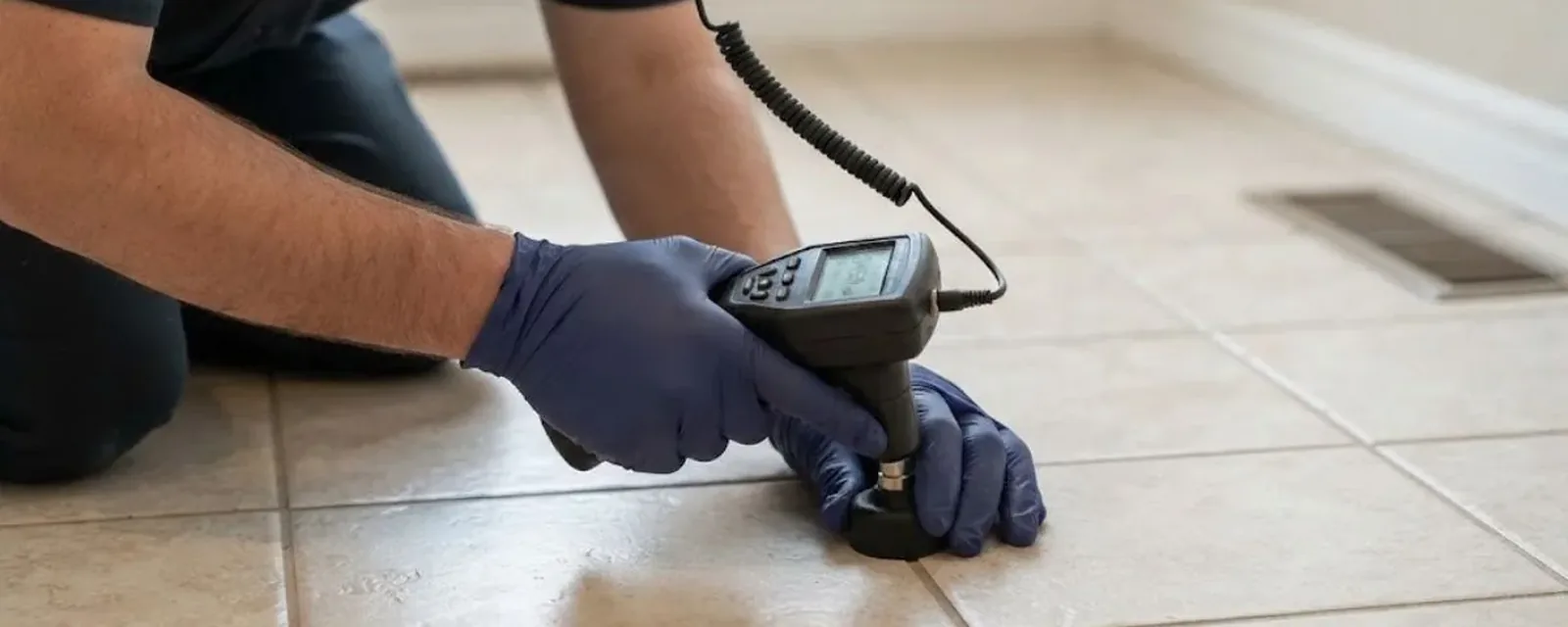
Leak detection with helium means a plumber isolates a section of pipe, empties it of water, fills it with helium or a hydrogen and nitrogen blend, and then scans the floor or wall with a sensitive sniffer. Wherever the gas escapes, the sniffer reads a spike. It is a pinpointing tool for pipes you cannot see, such as a line under a slab, and it is rarely the first thing a plumber tries.
Most leaks are confirmed with a much cheaper step first: a meter test you can run yourself. This guide covers that test, how tracer gas works, how it compares with acoustic, thermal, pressure and camera methods, and the honest limits of every one of them.
Prove there is a leak before paying to find one
A spinning meter with every fixture off is the clearest sign of a supply leak. This takes about fifteen minutes and needs no tools.
Stop all water use
Close taps, stop the dishwasher and washing machine, and make sure nobody flushes a toilet during the test.Read the meter
Find the small low-flow dial or triangle on the meter face. If it turns with everything off, water is moving somewhere.Rule out the usual suspects
Add a few drops of food coloring to each toilet tank and wait without flushing. Color in the bowl means a leaking flapper, not a buried pipe.Check the ice maker and softener lines
Small supply lines to a fridge or humidifier can drip for weeks behind an appliance.Close the main and watch again
Shut the main valve inside the house and read the meter again. A dial that keeps moving means the leak sits ahead of your shutoff. A dial that stops means the leak is somewhere inside the house.
How a gas actually finds a hole in a pipe
Helium atoms are tiny and light, so they slip out of openings that water has not yet found. Hydrogen blends behave the same way. The common blend is a small share of hydrogen mixed into nitrogen, which is not flammable at that mix.
The plumber closes off the line at both ends, drains it, and feeds the gas in at low pressure. Gas that escapes rises through soil, concrete, or drywall. A handheld sensor reads it at the surface, and the strongest reading marks the spot to open.
Because the gas rises, the reading can sit slightly off the real hole when it travels along a pipe sleeve or a gap in the slab. A good operator scans in a grid and marks the peak, then confirms with a second method before cutting anything.
Which leak finding method fits which situation
Plumbers often combine two or three methods. Ask what the plumber plans to use and why.
| Method | Works best for | Where it struggles |
|---|---|---|
| Meter test | Confirming a supply leak exists at all | Cannot say where the leak is |
| Pressure test | Showing whether a closed line holds pressure | Gives a yes or no, not a location |
| Acoustic listening | Pressurized lines with a hissing leak | Noisy plastic pipe, deep lines, background traffic noise |
| Thermal imaging | Hot water lines and radiant floors that warm a surface | Cold lines and leaks that do not change surface temperature |
| Camera inspection | Open drain and sewer runs a camera can physically enter | Pressurized supply pipes, which a camera cannot enter |
| Tracer gas | Isolated lines under slabs or behind finished walls | Lines that cannot be isolated and drained, or hole sizes too large to hold gas |
No single method finds every leak. Pairing a pressure test with a second method is common.
When tracer gas is worth considering
Gas earns its place when the meter proves a leak, the leak is hidden, and listening or heat have not settled the location. A warm patch on a floor, a damp slab edge, or a pipe run behind tile are typical cases. Opening the wrong spot costs real money, so a confirmed mark saves repairs.
It also helps on a closed heating loop or an isolated branch where water cannot be left in the line. If you suspect a leak near a heated floor, tell the plumber, because the heating system changes which method works.
What a gas test cannot do
Tracer gas finds an exit point. It does not tell you why the pipe failed, how much water has been lost, or whether neighboring pipes are about to fail too. Honest limits matter before you agree to the work:
- It does not work on a line that cannot be shut off and drained at both ends.
- It does not find leaks in a drain line that is only wet when you run a fixture.
- It does not measure damage already done to framing or insulation.
- It does not replace repair. The pipe still has to be opened and fixed or replaced.
- It cannot promise one hole. A pipe with pinholes in several places may need replacing instead.
What to ask before the work starts
The plumber should explain the plan plainly and settle the price before any floor is opened. Use these questions to compare answers from two companies:
- Which method will you use first, and what will make you switch to another?
- What tools do you bring for acoustic, thermal and gas work, and who operates them?
- Will you confirm the location with a second method before cutting?
- What happens to the water and heat while the line is drained?
- What does the price cover if the leak turns out to be in a different line?
If a pipe has already burst or water is spreading
Skip the detective work. Shut the main, open a low faucet to drain the pressure, and keep electronics and cords away from wet areas. Active flooding is a job for burst pipe repair, and finding the cause can wait until the water is off.
Milton, MA specifics: who owns the pipe and how old it is
Source type: Town of Milton service line page and Housing Production Plan (Jan 2020)
Milton's share of the water line ends at the curb stop valve, the shutoff that links the street main to your service pipe. From that valve to the house, the owner is responsible. A leak on your side is yours to fix, while one on the street side is a call to the Town's water division.
Nearly half of Milton's homes (46.8%) date to 1939 or before, and the median home is 71 years old, according to the Housing Production Plan. Houses that old tend to carry a mix of original and replaced pipe, so one failed section may not be the only weak spot. Ask the plumber to check nearby pipe while the wall or floor is open.
Questions readers ask about this topic
The gas is not toxic and the common hydrogen blend is not flammable at that mix. The plumber should still ventilate and keep the test area clear of people and pets. Ask how the line is isolated so water or gas cannot move into other fixtures.
No. The method needs sealed fittings, controlled pressure and a calibrated sensor. You can do the meter test and the toilet dye test yourself, and those two steps tell you whether paying for a locating method makes sense.
Setup, draining and scanning often take a few hours, depending on pipe length and how easy the line is to isolate. The plumber should give a time frame after seeing the layout, not before.
Coverage for a hidden leak varies. Policies often pay for abrupt damage but not for wear or slow seepage, and locating costs may be handled on their own terms. Your actual contract decides, so put the question to the insurer before the work begins.
Tell the plumber the wall type and the age of the pipe. A tracer gas test can mark the wall spot so only a small opening is cut. Older galvanized or mixed pipe may be better replaced than patched, and a leak detection visit can decide that.
Rather talk it through? Call and ask a plumber.
(617) 752-0573