
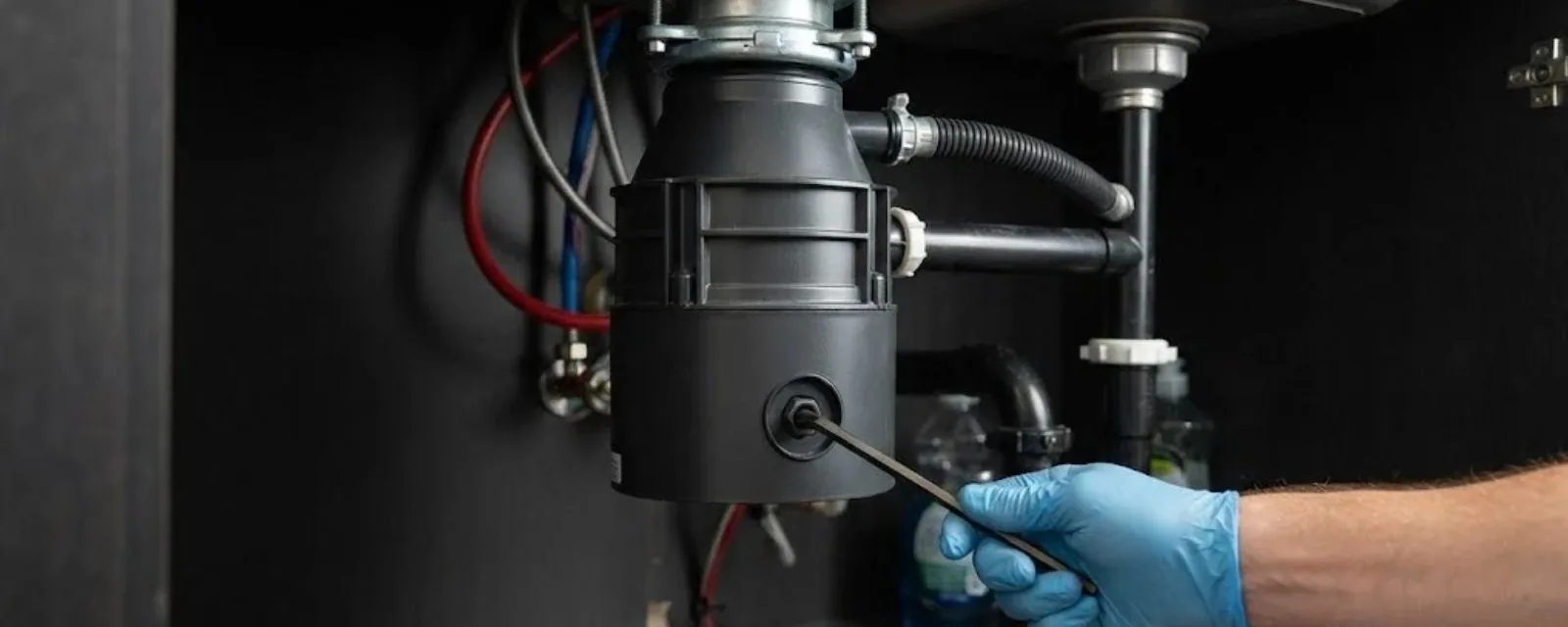
Most kitchen garbage disposal repair starts with one of three problems: a jam that makes the unit hum, a unit that is completely dead, or a leak under the sink. A jam usually clears with a hex wrench and the red reset button. A dead unit is often a tripped reset or breaker. A leak depends entirely on where the water shows up.
Before any of that, cut the power at the breaker or unplug the unit, and never put your hand inside the grinding chamber. The steps below keep your fingers out of the unit and tell you when the repair is not worth doing.
Make it safe first
A disposal has a motor, sharp lugs on a spinning plate, and a wall switch that someone can flip while you are working. Treat it as live until you have proved it is not.
Unplug the cord under the sink if it has one. If the unit is hard-wired, switch off its breaker and tape the switch. Then use a flashlight and long tongs or pliers to remove anything visible, never your fingers.
Clearing a jam when the motor only hums
A hum with no spinning means the motor is getting power but the plate is stuck. Bones, fruit pits, a bottle cap or a utensil are common causes.
Power off
Unplug the disposal or turn off its breaker, then confirm the wall switch does nothing.Find the hex socket
Look under the unit for a small hex socket in the center of the bottom. Most disposals come with a matching hex key.Work the wrench
Seat the key and swing it side to side until the plate spins a full turn without catching.Remove the blockage
Use tongs to pull out whatever you can see from the top.Press reset
Press the red button on the bottom of the unit. If it pops back out, wait ten minutes and try again.Restore power and test
Run cold water, flip the switch for a few seconds, and listen for a smooth sound.
Symptoms and likely causes at a glance
| What you notice | Likely cause | Safe first move |
|---|---|---|
| Hum, no spin | Jammed plate | Power off, hex key, reset |
| Silent, no hum | Tripped reset or breaker, failed switch | Press reset, check the breaker |
| Spins but sink drains slowly | Clog beyond the unit | Remove debris, then call about the drain line |
| Loud rattle or metal sound | Foreign object or worn parts | Power off and look with a flashlight |
| Smells bad | Food film on the splash guard and chamber | Scrub the rubber baffle, flush with cold water |
| Water under the sink | Seal or hose leak | Find the location with the next section |
Where the water is coming from tells you the fix
Dry the cabinet floor and the unit, then run water and watch. Use paper towels held under each joint to see which one gets wet first.
- Leak at the top flange under the sink basin: the mounting ring or putty seal has failed. It needs to be loosened and reset.
- Leak from the side near the dishwasher: the drain hose clamp is loose or the hose is cracked. Tightening the clamp is often enough.
- Leak from the discharge pipe: the gasket between the unit and the drain elbow has worn, or the bolts are loose.
- Leak from the bottom or a seam in the body: the internal seal has failed. The unit usually needs replacing.
- Drip from a reset button: this also signals a body leak, and the unit should stop being used.
The dishwasher connection that surprises new owners
The dishwasher drains into a side port on the disposal. A new unit ships with a plastic knockout plug inside that port. If nobody removes it, dishwasher water cannot leave and the dishwasher fills with gray water.
Check the hose path too. The dishwasher drain hose should loop high under the countertop before it meets the disposal, so sink water cannot flow back into the machine.
Repair or replace the disposal
A clear price before work starts makes this decision easier. Ask the plumber to compare both options in writing.
| Situation | Repair makes sense | Replacement makes sense |
|---|---|---|
| Jam | Cleared with a hex key | Jams return weekly |
| Leak | Loose clamp, flange or gasket | Water from the body or a seam |
| Motor | Reset works and it runs smoothly | Hums every time or trips the breaker |
| Age | Newer unit with a single fault | Several faults on an old unit |
| Fit | Same mounting and drain position | Needs a different size or new drain parts |
When the unit is completely dead
Silence usually has a simple cause. Start with the red reset button on the bottom, then check the breaker for that kitchen circuit. A unit that plugs into an outlet under the sink may share a circuit with a GFCI outlet that has tripped.
If the reset holds and the breaker is on but the motor stays silent, the switch or the motor has likely failed. Wiring work on a hard-wired unit belongs with a licensed professional. For a full replacement, ask the town inspector whether a permit applies.
Habits that stop the next jam
Run cold water before, during and for about fifteen seconds after grinding. Cold water keeps fats solid so they get chopped and flushed instead of smearing down the pipe.
Keep these out of the unit: grease and oil, coffee grounds in volume, fibrous peels, rice and pasta, bones, and anything that is not food. A disposal helps with scraps. It is not a trash can. Manufacturer instructions are the standard guide for what a given unit can handle, so check the manual for your model.
Milton, MA specifics: older kitchen drains and storm surge
Source type: Milton housing plan and 2020 resilience workshop
The median Milton house is 71 years old. A kitchen drain in a house that old often leads to aging pipe with rough walls where grease catches. If your sink drains slowly even after the disposal is cleared, ask a plumber to look at the line beyond the trap.
Workshop participants in 2020 described East Milton storm surge pushing sewage back into houses. If the kitchen sink gurgles or fills during a high-tide storm, the disposal is not the cause, so do not take it apart. Stop using water and have the sewer connection checked.
Questions readers ask about this topic
The motor has power but the plate is jammed. Turn off the power, work a hex key in the bottom socket until the plate moves freely, clear anything visible with tongs, and press the red reset. If it still hums, the motor may be worn out.
No. Chemical cleaners can sit in the chamber, splash on you when the unit is serviced, and damage seals. Snake or plunge instead, or have the line cleaned through drain cleaning.
No. Leaks at the top flange, drain elbow or dishwasher hose are often repairable. A leak from the body or the seam means the internal seal is gone, and replacement is usually the sensible route.
Either setup is common. A hard-wired unit needs its breaker off before service. Replacing a hard-wired unit involves electrical connections, so confirm who is handling that part in the quote.
Each town sets its own rules, and some have sewer and septic considerations. Ask the local building department before installing a new unit. For service on any disposal, garbage disposal repair covers the repair side in Randolph and Braintree too.
Usually not. A gurgle or backup during heavy rain points to the sewer line or a surge from the street, not the grinder. Stop running water and call for a line inspection.
Rather talk it through? Call and ask a plumber.
(617) 752-0573