
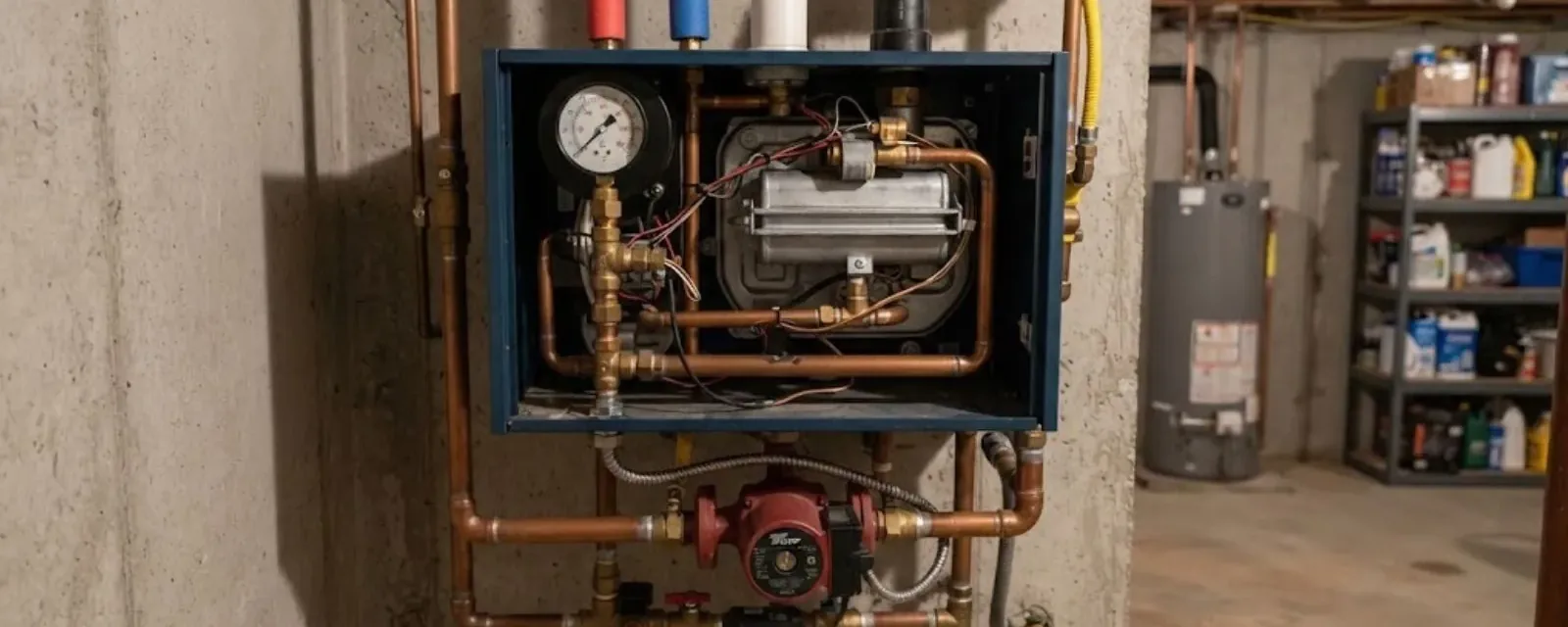
Boiler cover comes from two different places, and they do not overlap much. A service plan or maintenance contract from a heating company covers inspections and, depending on the terms, repairs to the boiler itself. A standard homeowners policy tends to respond to abrupt, accidental water damage, and tends not to cover a worn-out boiler or damage from a leak that went on for months.
The exact policy wording decides every case. This guide shows what a good plan should list, what insurers commonly include and exclude, and the questions to put to any provider before you sign.
Plan, policy or neither: who usually pays for what
These are common patterns, not promises. Your documents and your insurer have the final say.
| Situation | Service plan may cover | Homeowners policy may cover |
|---|---|---|
| Yearly tune-up and safety check | Yes, that is the main purpose | No, this is maintenance |
| Worn pump or failed thermostat | Depends on the parts listed | Usually no, this is wear |
| Boiler stops on a cold night | Only if emergency visits are included | No, unless a covered event caused it |
| Sudden burst pipe flooding a room | Rarely, plans focus on the boiler | Often yes for sudden damage, subject to the policy |
| Slow leak from a fitting over months | Maybe the fitting, not the damage | Often excluded as gradual |
| Full boiler replacement at end of life | Usually not | Usually not |
Ask the insurer how it treats the boiler itself versus the damage it causes.
What a homeowners policy does and does not do
Standard policies often respond to abrupt water losses, such as a pipe that bursts or a boiler tank that ruptures. They tend to exclude wear, rust, corrosion, lack of maintenance and slow leaks.
That means a boiler that dies of age is your cost, while the ceiling it floods may be an insurance question. Photograph everything, shut off the water and fuel, and call the insurer before throwing damaged materials away.
What a good boiler service plan should list
Plans vary a lot in what they include. A one-page summary is not enough, so ask for the full terms and check these points:
- Which boiler types, ages and fuels are covered, and which parts are named.
- Whether the plan pays for parts, labor, or only one of them.
- Whether emergency visits after hours are included, or billed separately.
- How many yearly inspections come with the plan and what the checklist contains.
- What is excluded: pipes, radiators, tanks, controls, chimney or venting.
- A limit on any single repair, and a yearly cap on total payouts.
- Whether work must be done by the plan holder's own technicians.
- How to cancel, and whether the plan transfers when you sell the house.
What a yearly service visit should actually include
A plan is only as good as the visit it pays for. A real service visit goes beyond a quick look and a signature.
Ask the plumber to walk you through the list: the burner or ignition, the safety shutoffs, the pressure relief valve, water level or pressure, the circulator pump, the expansion tank, and the flue or venting. The visit should end with a short written note about anything close to failing.
Signs the boiler needs attention before it fails
Boilers usually warn you first. Call for service when you notice any of these:
- Radiators that stay cold at the top or the far end of the house.
- Banging, kettling or whistling from the boiler or pipes.
- Pressure that keeps dropping and needs topping up.
- Rust stains or damp patches under the boiler or at valves.
- A pilot or burner that keeps going out, or soot around the cabinet.
- A heating bill that climbs without a change in weather or habits.
How to compare two plans side by side
Get both plans in writing
Ask for the full terms, not the brochure.Match the boiler
Confirm the plan names your boiler type, such as steam or hot water, and its fuel.List the exclusions
Put the excluded items side by side and note which ones break most often in your house.Price per visit
Compare what each plan charges when a part fails and when no repair is needed.Ask about priority
Find out whether plan holders get any scheduling priority and how that is stated.Check the plumber
Look up the technician in the state's eLIPSE licensing portal, or phone 617-727-9952.
Repair now or replace: what the repair quote should show
A repair quote should name the failed part, the work to replace it, and what else is likely to wear soon. If the boiler is old, expect the plumber to talk about whether another repair makes sense.
With the price settled before work starts, you can weigh a repair against a replacement. A boiler repair is usually the right step for one failed part. When repairs repeat or the heat exchanger fails, ask for a written replacement quote through plumbing installation so you can compare in one sitting.
Keep every invoice and service note in one folder. Records show an insurer that the boiler was maintained, and they help a new plumber understand the history without guessing.
If the boiler is leaking, hissing or you smell gas
If you smell gas, get everyone outside first. From outside, phone 911 or your gas utility, and only then call a plumber.
- At a gas smell, touch no switches and use no phone inside. Walk out and dial 911 or your gas utility.
- For a water leak, switch the boiler off at its emergency switch and close the water feed valve.
- Place a pan under the drip and keep people away from hot pipes.
- Take photos of the damage before cleaning up, since the insurer will ask.
- Call the 24/7 emergency line and describe the noise, leak or error light.
Milton, MA specifics: how common boilers are here
Source type: Federal home energy survey (2020) and Milton Housing Production Plan
In a 2020 federal energy survey, 26% of occupied Massachusetts homes used a steam or hot-water boiler for heat. With that many boilers around, service plans are common, so shop two or three before signing. Ask each provider whether it services your boiler type.
The median Milton house is 71 years old by the town's own count. Older houses often have older heating systems, so ask any plan provider what age limits apply to the boiler and its controls.
Questions readers ask about this topic
No. A service plan is a contract with a heating company for maintenance and certain repairs. Insurance pays for covered losses under a policy. Neither one automatically replaces the other.
Usually not when the boiler fails from age or wear. It may cover sudden damage caused by a covered event. Read the policy or ask the insurer, since wording decides.
Most makers call for a yearly service before the heating season. A service visit checks safety controls, combustion, venting and water level or pressure. The plumber should explain what was tested.
Check the terms. Some plans transfer to the new owner and some end on sale. Ask before you buy, and keep service records because buyers often ask for them.
Often yes. Steam systems use different controls, traps and water-level devices, so a plan written for hot-water boilers may not name steam parts. Ask the provider to list steam components if your house has steam heat.
Rather talk it through? Call and ask a plumber.
(617) 752-0573